Tag: brain

  • The best way to sit still is to keep moving

    The best way to sit still is to keep moving

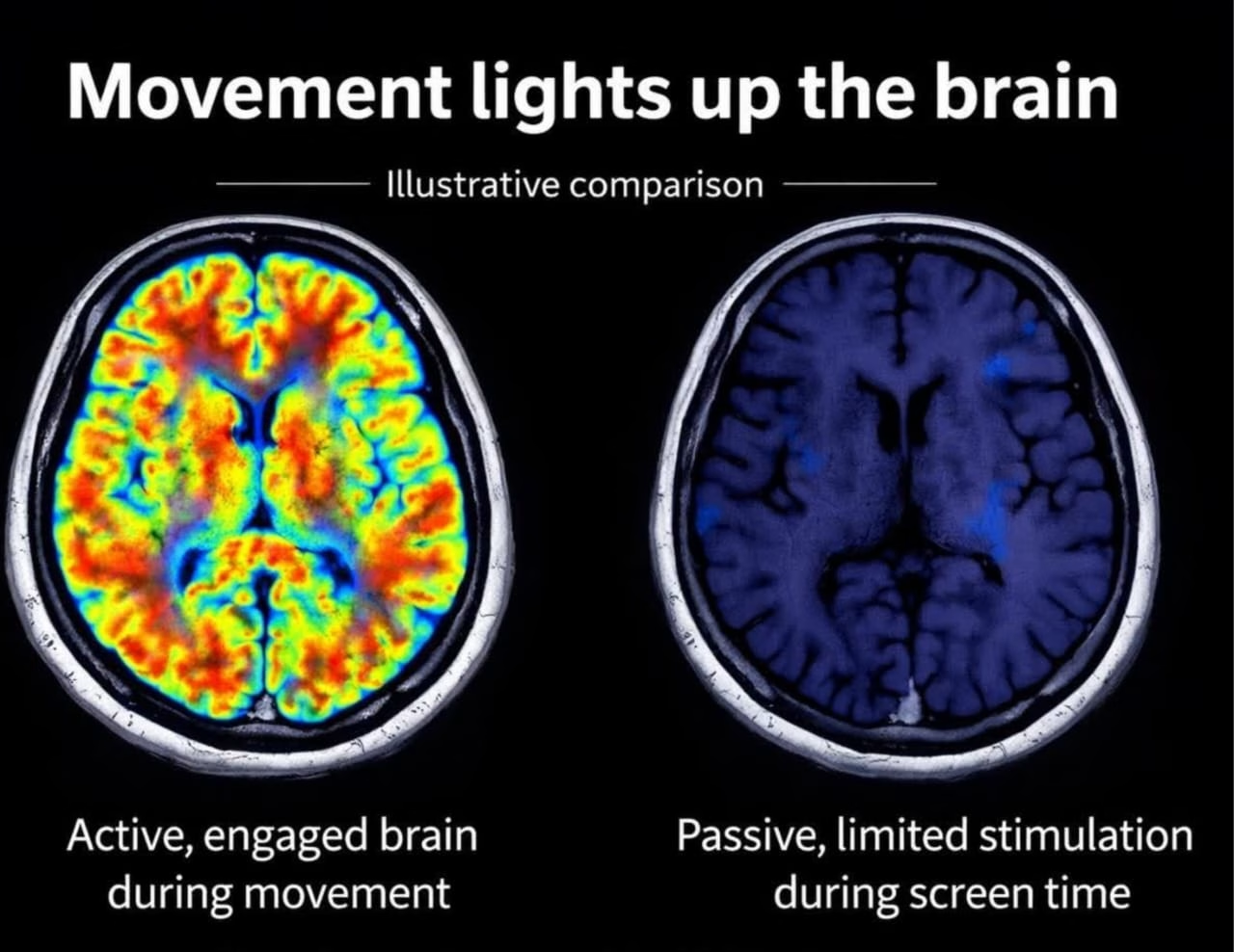
    Take a look at the two brains. One is a dim, quiet landscape of passive screen time; the other is vibrant – a “lit up” map of neural activity. The difference? Movement. For a Foundation Phase learner, movement isn’t a distraction from the lesson – it is the engine that drives it. When we tell a child to “sit still and listen,” we are actually asking their brain to perform a massive feat of endurance that leaves very little energy left for learning. Here is why we need to trade the “quiet classroom” for a “moving mind”.

    Dr. Eric Jensen, a leading educational neuroscientist, notes that the cerebellum contains nearly half of the brain’s neurons and has massive connections to the prefrontal cortex. When a child moves, they aren’t just burning energy; they are stimulating the neural pathways responsible for attention and decision-making.

    Historically, the cerebellum was thought to only control motor function. However, modern neuroimaging shows it is also highly active during cognitive processing. The same part of the brain that processes movement also processes spatial perception and language.

    Cross-lateral movements – activities where a child crosses the midline of their body (e.g., touching their left hand to their right knee) – are critical for Foundation Phase learnings.

    These movements force the left and right hemispheres of the brain to communicate via the corpus callosum.

    Studies on Neuroplasticity show that crawling, skipping and bilateral coordination strengthen the myelin sheath (insulation) on nerve fibers, which speeds up the transmission of information.  This is foundational for learning to read, as the eyes must track across a page (crossing the midline) smoothly.

    It is also important to note that movement increases blood flow, which delivers OXYGEN and GLUCOSE to the brain. BDNF (Brain-Derived Neurotrophic Factor) is often called “Miracle-Gro for the brain”, and physical activity triggers its release.  Research from the University of Illinois demonstrated that children who engaged in physical activity performed significantly better on executive function tasks and standardized tests than their peers.

    When we look at pre-schoolers, we’ve learned that the Vestibular (balance) and Proprioceptive (body awareness) systems are the gatekeepers of their focus.  A child who cannot sit still often has an “under-fueled” vestibular system.  They move because their brain is literally craving the input it needs to stay awake.

    So, let’s make it easier to understand:

    Type of MovementCognitive BenefitWhy it matters
    Crossing MidlineHemispheric integrationEssential for reading and writing (eye-tracking).
    Balance/SpinningVestibular stimulationImproves focus and settles the nervous system.
    Fine Motor PlayNeural densityHand-eye coordination correlates with later math success.
    Aerobic ActivityBDNF releaseIncreases memory retention and mood regulation.

    What this all means is that a quiet, still classroom isn’t necessarily a learning classroom. For a five-year-old, sitting still is a massive cognitive load that competes with the energy needed to listen.

    By incorporating movement, we reduce that load and allow the brain to focus on the message, not just the chair.

  • How music benefits your brain

    Music provides numerous benefits to the human brain. Exposure to music education helps children cognitively, academically, socially, as well as helping with emotional regulation.

    Music and Cognitive Development

    Music education can positively impact cognitive development in children. Learning to play an instrument can improve a child’s spatial-temporal skills, which are crucial for tasks such as mathematics, science, and engineering. This is because playing music requires the use of both hemispheres of the brain, which strengthens the connections between them and enhances the ability to solve problems that involve spatial reasoning. Plus, music education at a younger age has more benefits in terms of a brain’s neuroplasticity that has a lifelong impact. A study published in the journal “Frontiers in Neuroscience” in 2016, examined how neural connections are created from musical training in children. The study found that musical training was associated with changes in brain structure and function, including increased grey matter volume in areas related to auditory processing, motor control, and executive function. The researchers concluded that “the results of this study suggest that musical training has the potential to induce neuroplastic changes in the brain that may have a beneficial effect on cognitive and motor function.”

    Music and Academic Performance

    Music education has also been linked to improved academic performance in children. Research has shown that children who study music tend to perform better in other academic subjects such as math, science, and reading. This is because the cognitive skills developed through music education can transfer to other areas of learning. Music education can also improve memory and language skills in children. The process of learning to read music and play an instrument requires a great deal of memorization and attention to detail, which can enhance memory retention and recall. Additionally, music education can improve language skills by promoting phonological awareness and auditory processing, which are essential for learning how to read and write.

    Music and Emotional Regulation

     In addition to cognitive benefits, music education can also have a positive impact on emotional regulation in children. Learning to play an instrument can be a challenging and sometimes frustrating process, but it also provides an opportunity for children to develop resilience and perseverance. Moreover, playing music can be a cathartic and an emotionally expressive activity, which can help children manage stress and regulate their emotions. Research has shown that music can also have a calming effect on the brain and body. Listening to music can activate the parasympathetic nervous system, which is responsible for the “rest and digest” response and can lower heart rate and blood pressure. This can be especially beneficial for children who struggle with anxiety or other emotional challenges.

    Music and Social Development

    Music education can also promote social development in children. Learning to play an instrument in a group setting, such as a band or orchestra, requires teamwork and communication skills. Children who participate in music ensembles must learn to listen to others, follow a conductor, and coordinate their playing with the rest of the group. These skills can translate to other social contexts, such as team sports or group projects in school. Moreover, music education can also provide a sense of community and belonging for children. Being part of a music ensemble can create a sense of shared purpose and identity, which can be especially important for children who may feel isolated or disconnected from their peers. Learning to play an instrument or sing can be a fun and rewarding activity for children, and the skills they develop. can